


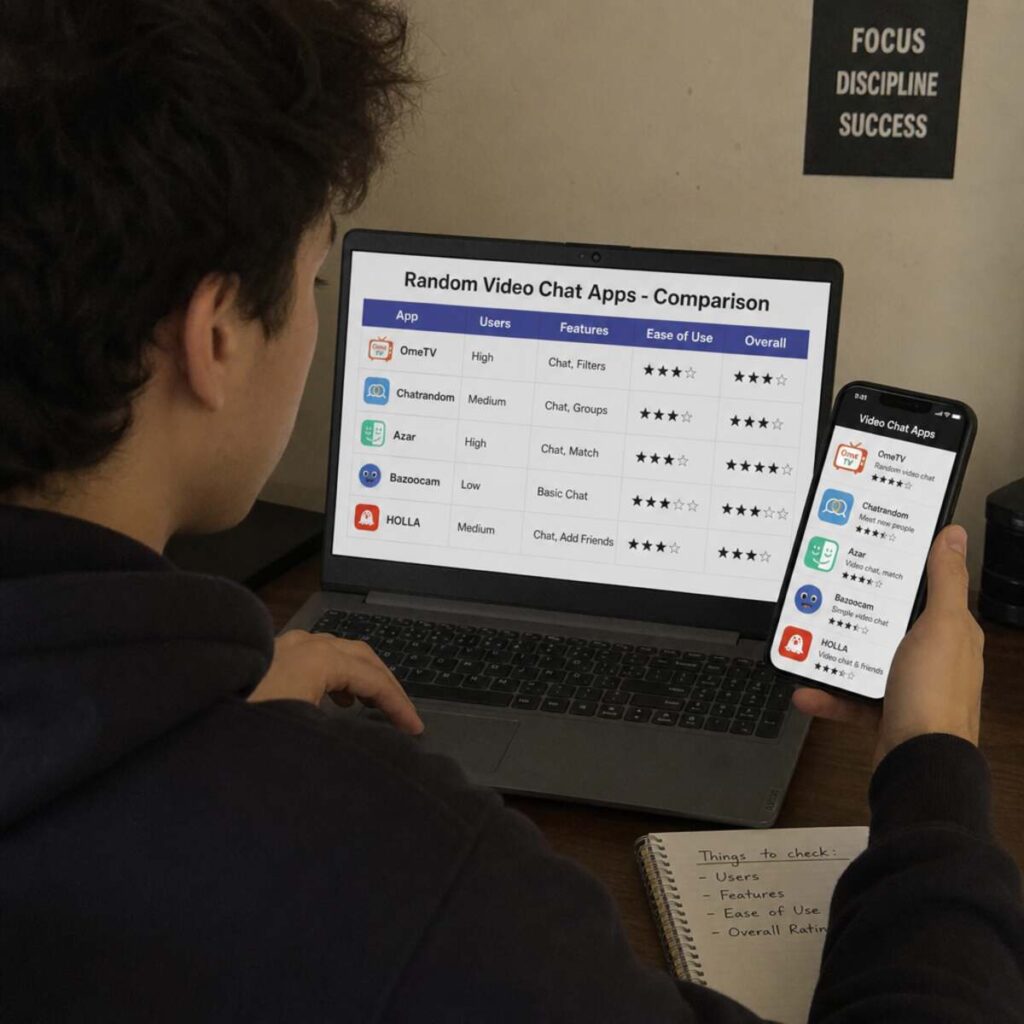
Looking for apps like OmeTV that still give you the quick, face-to-face feel of random video chat? This page gives you a clear, practical way to compare popular online video chat options, choose the right platform for your mood, and avoid the safety mistakes that make stranger chat risky. Use it as a quick decision guide before you open your camera, create an account, or download a new app. Get the Best information about ısparta escort.
Suggested meta description: Compare top alternatives to OmeTV for chatting, including random video chat apps, key features, safety tips, privacy checks, and the best options for casual conversations.
Which OmeTV alternative should you try first?
Start with the app that matches the kind of conversation you actually want. If you want the closest classic random-chat feel, look at Chatroulette, Shagle, Camsurf, or Chatspin. If you want better conversation starters, Emerald Chat is useful because it emphasizes interest matching and multiple chat modes. If you care most about international discovery, Azar is worth checking because its app listing highlights global video chat and real-time voice-to-subtitle translation.
Here is the simple rule I give people: do not pick a random video chat app only because it is popular. Pick it because its controls fit your comfort level. A platform with country filters, reporting tools, age rules, or moderation may feel very different from one that is built around pure randomness. The “best” OmeTV alternative is the one that helps you meet new people without making you give up common sense, privacy, or control.
Quick CTA: Scan the options below, choose your top two, then test each for five minutes with your camera covered or disabled until you understand the controls.
The best OmeTV alternatives at a glance
Below are the main platforms people often compare when searching for Apps like OmeTV. Some lean toward fast stranger matching. Some add filters. Some feel more like social discovery apps. None of them removes all risk, so treat this as a starting point, not a guarantee.
Chatroulette
Chatroulette is one of the best-known names in random video chat. Its current site describes it as an original free random video chat platform with worldwide matching, mobile apps, text chat options, country and language preferences, and AI plus human moderation. It also states that the service is for adults and prohibits sexually suggestive content.
Choose Chatroulette if you want a familiar, simple experience that feels close to the classic “talk to a stranger now” format. It works best when you want quick conversations without building a detailed profile first. The tradeoff is that fast matching can also mean fast skipping, so you need a simple opener ready.
Best fit:
- People who want a classic random video chat experience
- Users who prefer simple start-and-skip matching
- Adults who want country or language preferences
- Anyone who wants both video and text options
Emerald Chat
Emerald Chat positions itself as an Omegle-style alternative with random matching, text chat, video chat, group chat, interest matching, media sharing, anonymous usage, and filters such as gender or karma rating. Its site also highlights 24/7 moderation, a karma system, anti-bot measures, and an 18+ policy.
Choose Emerald Chat if your biggest complaint about OmeTV is that conversations feel too random. Interest matching gives you a better chance of opening with something real, like music, gaming, travel, school, work, sports, or movies. It is still random chat, so you should stay cautious, but it gives you more structure than a plain next-button experience.
Best fit:
- People who want shared-interest matching
- Users who like text, video, and group modes
- Anyone tired of bots or low-effort chats
- Adults who want a platform that talks openly about moderation
Camsurf
Camsurf is a random chat site where users can communicate through text, microphone, or webcam. Its FAQ says users can start by allowing camera access and pressing start, and it notes that the service keeps the random-chat concept simple while offering location filtering.
Choose Camsurf if you want a lighter, less complicated option. It is better for people who do not want a long list of controls before every chat. The main benefit is ease; the main limitation is that fewer filters may mean less precision in who you meet.
Best fit:
- People who want a simple random chat tool
- Users who like location filtering without too much setup
- Anyone who wants text and webcam communication
- Casual visitors who plan to chat briefly
Shagle
Shagle promotes instant random video chat, anonymous use, country selection, gender filtering, virtual gifts, and connections with people in many countries. Its official site says basic video chat is free, while some filters may be premium depending on the feature.
Choose Shagle if you want more control than a purely random app, especially around location. It can be useful if you want to talk with people from a specific country, practice a language, or avoid being matched only with whoever appears first. Check current feature access before you commit to any paid upgrade.
Best fit:
- People who want country-based matching
- Users who like anonymous chat without heavy setup
- Anyone who wants optional filters
- Adults comparing free and paid random video chat features
Chatspin
Chatspin describes itself as a random video chat service for adults that supports live global chat. Its help pages mention face filters, emoji in text chat, general location indicators where available, gender filtering, free random video and text chat, and optional paid upgrades.
Choose Chatspin if you want random video chat with a more playful feel. Face filters and emoji can make first moments less awkward, especially if you do not want every chat to start with a serious introduction. It may suit people who like a casual app-like interface but still want basic control features.
Best fit:
- People who want video plus text chat
- Users who like face filters or light personalization
- Adults who want optional upgrades
- Anyone who wants a browser-friendly experience
Azar
Azar is a mobile-focused video chat app that connects people globally. Its Google Play listing says users can browse profiles, use video chat, access real-time voice-to-subtitle translation, and use subscription-based gender and region filters. The same listing also shows a Mature 17+ content rating in Google Play.
Choose Azar if you are more interested in social discovery than pure one-click randomness. The translation feature is especially helpful if you want conversations beyond English-only matching. Since it has app-based features, profiles, and paid options, take a minute to review settings before you start chatting.
Best fit:
- People who want international conversations
- Users interested in translation support
- Anyone who likes profile browsing before connecting
- Mobile users who prefer app-based chat
Monkey
Monkey is another name people often search when comparing OmeTV-style platforms. Its official site presents it as random video chat for talking to strangers instantly. Because Monkey has been discussed in online safety materials as a platform involving stranger video chat, users and parents should review current age rules, app permissions, and privacy settings carefully before using it.
Choose Monkey only if you understand how the app works and are comfortable with fast video matching. It may appeal to users who want a mobile-first, social style of chat. As with any stranger-chat app, avoid sharing your handles, school, workplace, neighborhood, phone number, or private images.
Best fit:
- Mobile users who want quick video conversations
- People comparing newer social chat apps
- Users who are willing to review privacy and safety settings first
- Adults or age-appropriate users following the current platform rules
Tinychat
Tinychat is different from a pure OmeTV replacement because it leans more toward live chat rooms, group conversations, private conversations, voice, video, and text. Its current live chat page describes options such as group chats, advice rooms, support groups, live video, voice chat, and random live chat with strangers.
Choose Tinychat if you do not always want one-on-one stranger matching. Topic-based rooms can feel more natural because there is already a shared reason to talk. If random video chat feels too abrupt, group rooms may give you a softer way to meet people online.
Best fit:
- People who like group chat rooms
- Users who want video, voice, and text options
- Anyone who prefers topic-based conversations
- Visitors who want less pressure than one-on-one matching
Comparison by chatting style
The easiest way to compare these platforms is not by asking, “Which one is best?” That question is too broad. Ask, “What kind of chat do I want tonight?” Once you answer that, the right choice gets clearer.
For quick random conversations:
- Chatroulette works well when you want the classic stranger-chat format.
- Camsurf keeps the experience simple and direct.
- Shagle adds more location control while keeping the random feel.
- Chatspin gives you random chat with playful features like face filters.
For more focused matching:
- Emerald Chat is stronger when you want interests to guide the conversation.
- Azar is stronger when you want to browse, translate, or connect across countries.
- Tinychat is stronger when you want topic-based rooms instead of nonstop one-on-one skips.
For casual browser use:
- Chatroulette, Camsurf, Shagle, and Chatspin are good places to start because they emphasize web-based or browser-friendly random chat.
- Browser use is handy if you do not want to install another app right away.
- Still, use the official site and check the privacy policy before allowing camera and microphone permissions. The FTC advises downloading apps directly from a service’s website or an official app store and reviewing privacy terms before using video services.
For mobile-first chatting:
- Azar is built strongly around the app experience.
- Monkey is commonly searched as a mobile random chat option.
- Chatroulette also promotes mobile apps for iOS and Android.
For international conversations:
- Azar stands out for translation support.
- Shagle stands out for country selection.
- Chatroulette highlights country and language preferences.
- Camsurf allows location filtering, though its FAQ says the platform keeps many parts of the experience random.
Key features to look for before you start
A good online video chat platform should not make you guess how it works. Before you press start, look for controls that help you manage your experience. You do not need every feature, but you do need enough control to leave quickly, report problems, and avoid exposing more than you meant to.
Use this checklist before trying any OmeTV alternative:
- Camera and microphone controls: You should know when your camera is on, when your mic is live, and how to turn both off.
- Next or skip button: Random video chat should let you leave a conversation instantly without arguing or explaining.
- Report and block tools: If someone is inappropriate, threatening, or suspicious, you should be able to report or block them quickly.
- Moderation policy: Look for clear rules against nudity, harassment, threats, hate speech, spam, and impersonation.
- Age rules: Check whether the platform is 18+, 17+, or another age level. Do not assume every app uses the same standard.
- Privacy policy: Read what the platform collects, how it handles reports, and whether chat data or images may be reviewed for safety.
- Filters: Country, language, gender, interest, and topic filters can make chats more relevant, but some may be paid.
- Text chat option: Text is useful when your connection is weak or you want to ease into the conversation.
- No-download option: A browser version lets you test the platform before installing anything.
- Account requirements: Some people like anonymous use; others prefer accounts because they may support reputation, badges, or moderation history.
A quick example helps here. Say you want to practice Spanish with people outside the US. A platform with country or language filters will probably serve you better than one with pure random matching. But if your goal is just a five-minute chat while you are bored, a simpler site may feel faster and less fussy.
CTA: Before you open any chat, pick your non-negotiables: “I need a skip button, reporting, clear age rules, and no required download.” If a platform does not meet your list, move on.
Safety and privacy basics for random video chat
Random video chat can be fun, but it is still a live conversation with a stranger. The person on the other side may be friendly, bored, funny, awkward, fake, pushy, or trying to scam you. Your job is not to be paranoid. Your job is to make smart defaults before the chat starts.
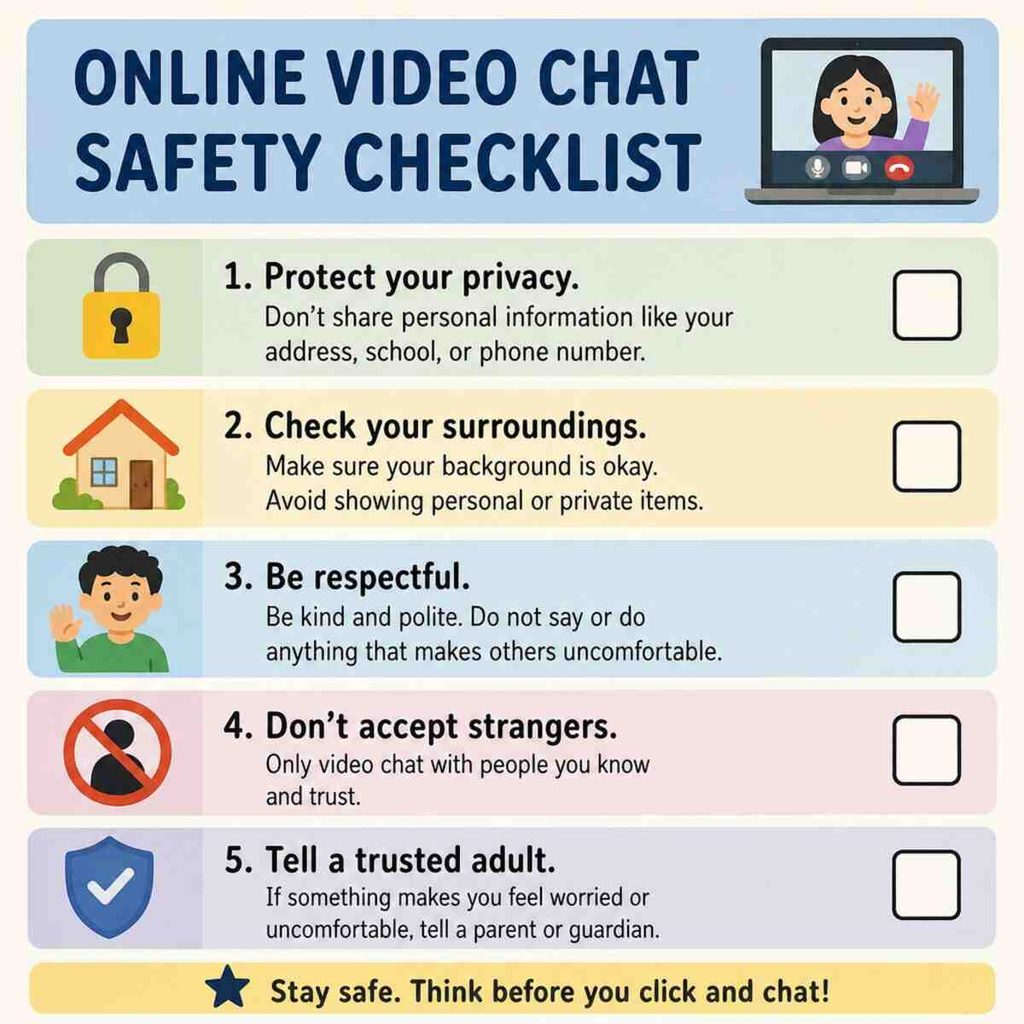
First, protect your personal information. Do not share your full name, address, school, workplace, phone number, email, financial details, daily routine, or exact location. Even small details can stack up. A college sweatshirt, a street sign in the window, a work badge, or a calendar behind you can reveal more than you intended.
Second, assume you might be recorded. The FTC’s video privacy guidance says the safest strategy is to assume recording is possible and avoid sharing private information over video. That advice fits random video chat perfectly because you do not control the other person’s device, screen recorder, or intentions.
Third, never send money, gift cards, crypto, banking information, or payment app transfers to someone you met through random chat. The FTC warns people not to send money or gifts to an online love interest they have not met in person. This applies even if the person seems sweet, says there is an emergency, promises to pay you back, or asks you to move the conversation to another app.
Fourth, take sextortion seriously. If someone threatens to share images, recordings, or personal details unless you pay or send more content, stop communicating and report it. The FBI advises targets of financially motivated sextortion to cut off contact and report the interaction.
Use this safety checklist every time:
- Keep your background plain.
- Use a nickname instead of your real name.
- Avoid showing IDs, mail, screens, family photos, or documents.
- Do not move to another app just because a stranger asks.
- Do not click links sent by strangers.
- Do not accept files, downloads, or “verification” links.
- Leave immediately if someone pressures, insults, threatens, or sexualizes the chat.
- Report behavior that violates the platform’s rules.
- Trust discomfort early. You do not owe anyone a second chance.
For parents and caregivers, the rule is even simpler: random video chat with strangers is not a casual kids’ activity. Many platforms are age-restricted, and age ratings or access rules can vary by app store, country, and service. Review the current platform rules, device permissions, and parental controls before allowing any young person to use these tools.

How to choose the right app in five steps
Picking between random chat apps is easier when you move step by step. This is the same method I teach for simplifying any messy decision: define the goal, remove bad fits, test lightly, review the result, and repeat only if needed.
Step 1: Name your chat goal
Write down one sentence before you start. Try “I want a quick casual chat,” “I want to practice a language,” “I want to meet people who like gaming,” or “I want a group room where I can mostly listen first.” This tiny step saves you from opening five apps and getting annoyed because none of them match your mood.
If your goal is speed, look at Chatroulette, Camsurf, Chatspin, or Shagle. If your goal is shared interests, look at Emerald Chat or Tinychat. If your goal is international discovery, look at Azar, Shagle, or Chatroulette.
Step 2: Check access and age rules
Before downloading or signing up, check the current age policy and app store rating. Chatroulette and Emerald Chat state adult-focused rules on their sites, while Azar’s Google Play listing displays a Mature 17+ rating. Rules may change, so confirm them directly on the platform before use.
This matters because safety tools are not a substitute for age-appropriate use. If a service says it is for adults, treat that as a boundary, not a suggestion. If rules are unclear, choose a different option.
Step 3: Review privacy and permissions
Before you allow camera and mic access, ask three questions. What information does the platform collect? What happens when someone reports a chat? Can you use the service without connecting social accounts or revealing personal details?
Do not rush this part. Camera and microphone permissions are powerful. A random chat app should not get more access than it needs for the conversation you want.
Step 4: Test with a low-risk setup
Use a plain background, good lighting, and no personal items in view. Start with text if the platform allows it. If you use video, keep the first test short.
Here is a simple five-minute test:
- Open the official site or app.
- Check where the mute, camera, next, block, and report buttons are.
- Start one short chat.
- Leave if anything feels off.
- Decide whether the platform feels worth a longer session.
That is enough. You are not signing a contract. You are testing whether the tool fits you.
Step 5: Keep only the apps that feel manageable
After testing, keep one or two options. Delete the rest or remove permissions. Too many random chat apps can turn into notification clutter, privacy risk, or simple distraction.
A good app should feel easy to leave, not hard to escape. If you feel pressured to pay, share more, stay longer, or move off-platform, that is useful information. Choose the platform that gives you control, not the one that creates the most urgency.
Recommended picks by use case
Different users need different tools. Here are plain-language recommendations based on common searches in the US for OmeTV alternatives.
Best for classic random video chat
Try Chatroulette first. It has the name recognition, simple random matching, and current messaging around AI and human moderation. It is a practical place to start if you want the classic version of online video chat without thinking too hard about setup.
Also consider Camsurf if you want a similarly simple flow with text and webcam communication. Camsurf’s FAQ makes the starting process sound straightforward: allow access, press start, and use location filtering if wanted.
Best for interests and better openers
Try Emerald Chat first. Random chats often fail because nobody knows what to say. Interest matching gives the conversation a starting point, which can make the first ten seconds less awkward.
Use interests that are broad enough to match people but specific enough to help. “Music” is fine, but “indie rock,” “K-pop,” “guitar,” or “concerts” can lead to better openings. “Gaming” is fine, but “Fortnite,” “cozy games,” “speedrunning,” or “RPGs” gives the other person something easier to answer.
Best for country or language filters
Try Shagle, Chatroulette, or Azar. Shagle promotes country selection, Chatroulette highlights country and language preferences, and Azar highlights translation features in its app listing. These are useful if your goal is not just to meet anyone, but to meet someone from a place or language background that interests you.
A small tip: do not open with “teach me your language.” That can feel like work for the other person. Try a normal opener first: “Hey, I’m trying to practice Spanish, but we can talk about music or food if that’s easier.” Give people an easy path into the conversation.
Best for playful casual chats
Try Chatspin. Face filters and emoji can soften the awkwardness of live stranger chat. If you are not trying to have deep conversations every time, those small features can make the experience feel lighter.
Still, playful does not mean careless. Keep the same safety rules. Funny filters do not change the fact that you are talking to someone you do not know.
Best for group rooms and lower-pressure talking
Try Tinychat. Group rooms can be easier when you do not want to carry the entire conversation yourself. You can join a topic, listen for a moment, and decide whether to participate.
This is a good option if one-on-one random video chat feels too intense. It also works well for people who prefer voice or text before going on camera.
Best for mobile social discovery
Try Azar if you want an app-first experience with profile browsing and translation. It is less like a bare-bones “next stranger” site and more like a global discovery app. That can be good if you want more context before chatting.
If you compare Monkey, review its current app rules and safety settings carefully. Fast mobile matching can be fun, but it also makes it easy to overshare quickly. Slow yourself down on purpose.
Conversation openers that work better than “hey”
The platform matters, but your opener matters too. A random video chat can go flat in three seconds if both people wait for the other person to be interesting. You do not need a perfect line. You need a simple line that gives the other person something easy to answer.
Try these openers:
- “What’s one good thing that happened to you today?”
- “I’m asking everyone this: best movie you’ve watched lately?”
- “Quick vote: beach trip or city trip?”
- “I’m trying to find new music. What song should I play after this?”
- “What’s a food from your city that people should try?”
- “I have five minutes. Give me your best random fact.”
- “I’m practicing small talk. Rate this opener from 1 to 10.”
- “What’s a hobby you could talk about for way too long?”
Here is the trick: ask questions that are easy, safe, and not too personal. Do not start with relationship status, income, exact location, politics, religion, or anything sexual. Those topics may come up naturally in adult conversations, but they are terrible openers for a stranger who has not decided whether you are normal yet.
You can also use the “share first, ask second” method:
- Share one harmless detail.
- Ask a related question.
- Give the other person room to answer.
Example: “I’m in the US and it’s been a long day, so I’m doing quick chats for fun. What do people usually do online where you are?” That is casual, clear, and not too intense.
Red flags that mean you should leave
Leaving is not rude. In random video chat, leaving is one of the main safety tools. If a platform gives you a next button, use it freely.
End the chat if someone:
- Asks for your full name, address, school, workplace, or phone number
- Pressures you to move to Snapchat, WhatsApp, Telegram, Instagram, or another app right away
- Sends links or asks you to download something
- Requests money, gift cards, crypto, or payment app transfers
- Asks for explicit images or tries to record sexual content
- Threatens to expose you, embarrass you, or contact people you know
- Claims they need urgent help but refuses normal verification
- Gets angry when you set a boundary
- Shows hate speech, harassment, nudity, or violent content
- Seems underage on an adult platform
If something serious happens, take screenshots of usernames, profile pages, messages, or payment requests if you can do so safely. Then use the platform’s report tool. For scams, the FTC directs people to report suspected fraud through its reporting system, and for sextortion threats, the FBI provides reporting options through its tip line and local field offices.
A better way to test OmeTV alternatives
Here is a simple before-and-after scenario.
Before: You search for Apps like OmeTV, click the first result, allow camera access, start chatting, and hope the platform is safe. You do not know where the report button is. You do not know whether filters are free. You do not know what personal info is visible. If something weird happens, you panic and close the tab.
After: You choose two platforms from this guide. You check the age rules, privacy policy, and main controls. You cover personal items in your background. You test each app for five minutes, using the next button whenever a chat feels off. You keep the one that feels easiest to control and remove permissions from the other.
That second approach is calmer. It also gives you a better chance of enjoying the fun part of random video chat: meeting someone you would never normally meet.
Start with a safer chat plan
You do not need to try every OmeTV alternative today. Start with one goal, one platform, and one safety boundary. That is enough.
Your quick-start plan:
- Pick your goal: quick chat, shared interests, language practice, group room, or mobile discovery.
- Choose one platform from the matching section above.
- Review the current rules, age policy, and privacy settings.
- Set up a plain background and avoid personal details.
- Test one short chat.
- Leave, block, or report anything that feels wrong.
- Keep only the apps that give you control.
Main CTA: Choose your top OmeTV alternative now, open only the official site or app store listing, and review the controls before you go live.
Secondary CTA: Want the lowest-pressure start? Begin with text chat or a group room before turning on video.
Random video chat should feel spontaneous, not reckless. With the right platform, a clear boundary, and a little preparation, you can keep the fun part while lowering the risk. Pick carefully, chat lightly, and remember that the best button in any stranger chat app is often “next.”