
Understanding the Rules of May I?
Looking for a fresh, engaging card game for your next family night? Meet “May I,” a classic that’s easy to learn but has one exciting feature that will have everyone on the edge of their seats, waiting for their chance to pounce. It’s the perfect way to bring a new level of friendly competition to the table. To learn more, check out Link CINTA78
At its core, “May I” is a “rummy-style” game, meaning your goal is to collect groups of cards, like three Kings or a sequence of Hearts. If you’ve played any rummy games before, you already have a head start. But what makes this game special is its namesake rule—a unique twist that allows players to grab cards out of turn, changing the game in an instant.
This guide will get you playing fast, walking through everything from the initial deal to the final score. Forget dense rulebooks; let’s get you ready for your first game.
What You’ll Need to Start Playing ‘May I’ Right Now
Ready to play? The number of decks you use for the “May I” card game setup depends on your group size. Grab your standard 52-card decks and Jokers, then shuffle them all together thoroughly.
- 2-4 Players: 2 decks + 4 Jokers
- 5-6 Players: 3 decks + 6 Jokers
Once shuffled, deal 11 cards face-down to each player. Place the remaining cards in a face-down pile in the center—this is your stock pile. To start the game, simply flip the top card of the stock pile face-up beside it. This single card creates the discard pile.
Your goal in ‘May I’ is simple: be the first person to get rid of all the cards in your hand. You’ll accomplish this by collecting your cards into specific combinations, which is the key to winning each round.
The Building Blocks of ‘May I’: Understanding Sets and Runs
To get rid of your cards, you need to arrange them into special groups called melds. There are only two different kinds of melds you need to worry about: Sets and Runs. Knowing the difference is the first step to playing the game.
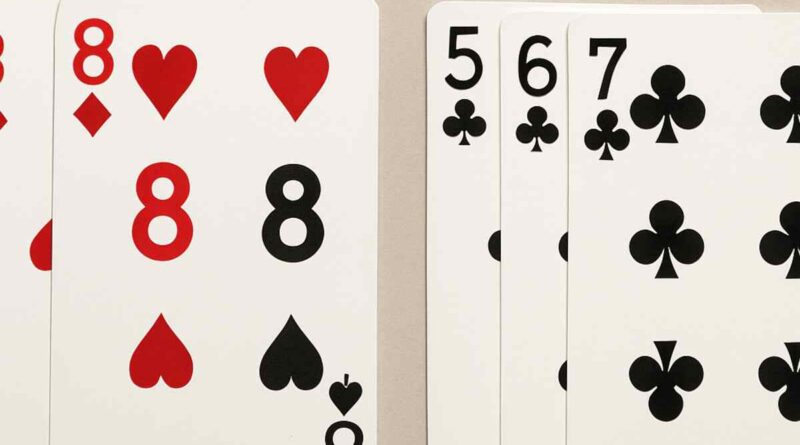
The first type of meld is a Set, sometimes called a ‘book’. A Set is a group of three or more cards of the same rank, like three 5s or four Kings. The suits for these cards do not have to match. For example, holding the 8 of Hearts, 8 of Diamonds, and 8 of Spades would be a valid Set.
Your other option is to build a Run. This is a sequence of four or more cards that are all in the same suit. A perfect example would be the 5, 6, 7, and 8 of Clubs. Unlike a Set, the cards in a Run must belong to the same suit—you can’t mix your Hearts and Spades here!
The specific Sets and Runs you need to collect change with each of the game’s seven distinct rounds, which is where ‘May I’ gets really interesting.
What Are the 7 Rounds? The Unique Phases of a ‘May I’ Game
This changing goal is what makes ‘May I’ so much fun. For each hand, you’re on a specific “mission” to collect an exact combination of Sets and Runs. Crucially, you cannot lay down any of your melds until your hand contains everything required for the current round. This list becomes your roadmap for the game.
Here are the seven missions you must complete, one for each round:
- Round 1: Two Sets of 3
- Round 2: One Set of 3 and one Run of 4
- Round 3: Two Runs of 4
- Round 4: Three Sets of 3
- Round 5: One Set of 3 and one Run of 7
- Round 6: Two Sets of 3 and one Run of 5
- Round 7: Three Runs of 4
As you can see, the requirements get tougher as the game progresses. Trying to build these bigger combinations might seem difficult, but thankfully, you have a secret weapon to help you complete these missions: wild cards.
How to Use Wild Cards: The Power of Jokers and 2s
In “May I,” all Jokers and all 2s give you a powerful advantage. Think of these as your “get out of jail free” cards. They are wild, meaning you can decide what card they represent to help you complete a Set or a Run. Using them effectively is essential, especially in the difficult later rounds.
Their most basic function is completing a Set. Imagine you’re trying to make a set of three 9s but only have the 9 of Clubs and 9 of Diamonds. If you also hold a Joker or a 2, you can place it with your other cards to create a valid Set. The wild card instantly becomes the third 9 you needed. This is a fundamental strategy for using wild cards in rummy-style games.
This flexibility is even more valuable for building Runs. Let’s say you have the 4, 5, and 7 of Hearts and need the 6 of Hearts to complete your run. A 2 can stand in for that missing 6, instantly bridging the gap. The joker rules in may i allow you to place a wild card anywhere in a sequence to complete it. But what happens when another player discards the card you need? That’s where the game’s most exciting rule comes into play.
The ‘May I?’ Rule Explained: How to Grab a Card Out of Turn
That frustrating moment when another player discards the exact card you need is where the game gets its name. If you see a card on the discard pile you want—and it isn’t your turn—you can immediately shout, “May I?” This requests to take that card out of turn. Being the first person to make the call gives you a chance to claim it, an action some players call buying the pile in may i. It’s a risky but powerful move.
Of course, a special action like this comes with a penalty. If you successfully claim the card, you must take the desired card from the discard pile, but you must also take the top card from the stock pile as a penalty. You get the card you needed, but now you have two additional cards, moving you further from going out.
After you take both cards, your turn is forfeited—you do not get to lay down any melds or make a discard. Crucially, the player whose turn it is has priority. If they want the discarded card, they can simply take it. Their right to the card overrules your “May I?” call, and you receive no penalty. Their turn then proceeds as normal.
Knowing when to take this risk is a key part of may i card game strategy. Since the “May I?” action forces you to skip your turn, you cannot go out during the action. You must wait for your next proper turn to declare you’re out.
How to ‘Go Out’ and Win the Round
The main objective is to be the first person to get rid of all the cards in your hand. This is called “going out,” and it’s how you stop play and trigger scoring for that round.
Your path to an empty hand opens up once your required melds are on the table. On your following turns, you can get rid of extra cards by playing them on any valid meld—yours or an opponent’s! For instance, if another player has a run of the 5, 6, and 7 of Hearts, and you have the 8 of Hearts, you can add it to their run during your turn. This powerful rule is key to emptying your hand quickly.
To officially win the round, you must play your remaining cards and end your turn by discarding your very last card. This classic way of going out in rummy-style games lets everyone know the round is over and gives your opponents one last chance to call “May I?” on that winning discard.
How Scoring Works in ‘May I’ (And How to Keep Track)
Once a player goes out, everyone else is stuck with the cards still in their hand. In a twist on many card games, the goal in ‘May I’ is to finish with the lowest possible score. This means you want as few points as possible when a round ends. The scoring is cumulative, adding up after each of the seven rounds.
The points are calculated based on the cards you’re holding. Higher-value cards and wild cards are riskier to hold, as they carry a bigger penalty. Here’s the breakdown:
- 3 through 9: 5 points each
- 10, Jack, Queen, King: 10 points each
- Aces: 15 points each
- 2s (Wild): 20 points each
- Jokers (Wild): 50 points each
Keeping track is simple. Just grab a piece of paper and make a grid with player names across the top and the seven rounds down the side. After each round, write down each player’s points. At the end of the game, add up the columns—the person with the lowest total score is the grand winner!
Your ‘May I’ Quick Reference: A Cheat Sheet for Your First Game
With the essential rules for setup, turns, and each round’s goal in hand, your first game is only a shuffle away. Start by dealing Round 1. Its simple objective of two sets is the perfect way to get everyone comfortable with the rhythm of drawing, melding, and discarding.
Don’t worry about memorizing every detail immediately. Instead, embrace the moment someone inevitably shouts “May I?!” for the first time. You now understand that this isn’t just a penalty—it’s the spark that transforms a simple card game into a lively and memorable night.